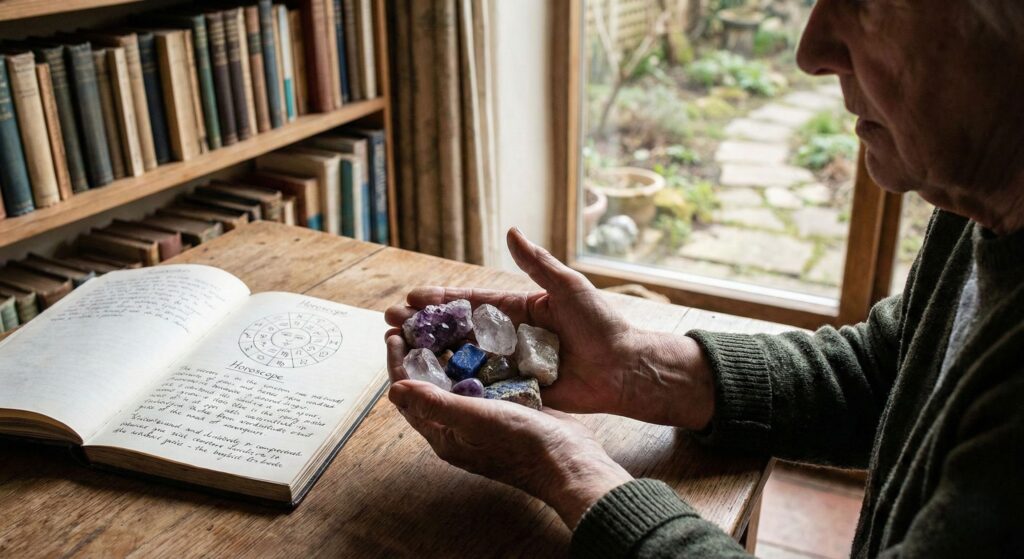
Can crystals and gemstones actually alter a person’s fixed karma?
Fixed Karma Cannot Be Changed: The sources explicitly state that there is a specific category of strong or fixed karma (referred to in the transcript as “jira Karma”) that “nothing in the world will change.” If a specific momentum of events is “supposed to happen anyway,” you have to go through it regardless of the crystals you use.
• Weak Karma Can Be Shifted: While fixed karma is immutable, the sources note that there are “weak karmas” and other types of karma that can be shifted through remedial measures, including the use of specific gemstones, worship of deities, or mantras.
• The Role of Gemstones: Rather than erasing fixed events, the primary role of gemstones and crystals in this context is to prepare your consciousness for the impact of those events. They serve as “remedial measures” (pariharam or upaya) to address problematic aspects of a horoscope, but their effectiveness depends on the individual and the judgment of the astrologer.
While the sources acknowledge that crystals act as “light consciousness in physical form” and can be used to cleanse energy or tune into information, they emphasize that one should not expect them to easily shift karma, especially those events that are pre-fixed for an individual
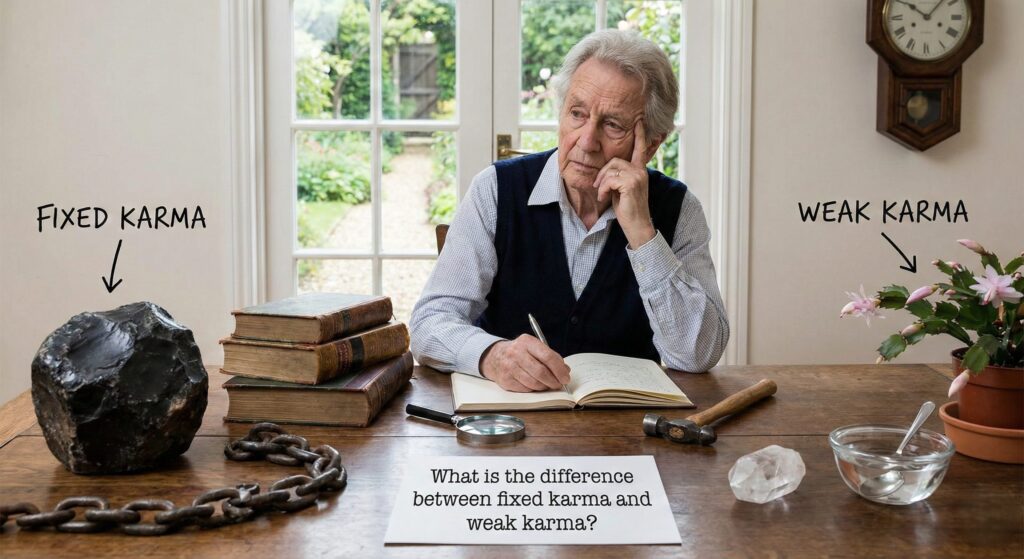
What is the difference between fixed karma and weak karma?
Fixed Karma (“Jira Karma”)
• It is Unchangeable: This type of karma represents a “momentum of events” that is destined to occur regardless of your actions. The source explicitly states that for this category, “nothing in the world will change” the outcome and “you have to go through that”.
• It Has a Strong Impact: These events are described as causing a “strong impact on your Consciousness” and are “prefixed” for the individual.
• Role of Remedies: Because you cannot change the event itself, the only purpose of remedial measures (like crystals or gemstones) in this context is to help prepare yourself for the event rather than prevent it.
Weak Karma
• It is Shiftable: Unlike fixed karma, the source notes that there are “weak karmas” that are pliable. You “can shift through” these karmas using remedial measures.
• Role of Remedies: For these weaker karmic influences, specific actions—such as wearing gemstones related to the planets (“grahas”), worshiping deities, or performing specific mantras—can effectively alter the behavioral patterns or the “story” associated with them.
In summary, while weak karma allows for intervention and change through spiritual or astrological remedies, fixed karma is an inevitable destiny where the focus shifts from changing the event to preparing one’s consciousness to endure it
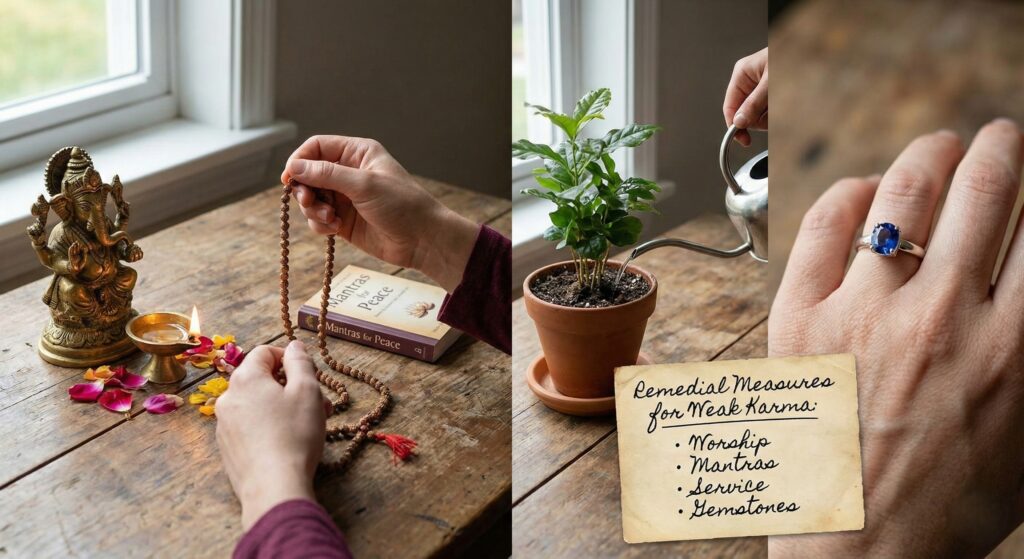
Which specific remedial measures help shift weak karmas?
• Worship of Deities: Engaging in the worship of specific divine figures.
• Specific Mantras: Reciting particular sacred sounds or formulas.
• Specific Activities: Performing designated actions prescribed to address the issue.
• Wearing Gemstones: Using specific gemstones that correspond to the planets (grahas).
The sources emphasize that while fixed (jira) karma cannot be changed by anything in the world, weak karmas are pliable and allow you to “shift through” them using these methods. However, it is noted that not every remedy works for everyone; a person looking at the horoscope must determine which specific measure is appropriate for the individual.
Harmonizing Destiny: A Comprehensive Guide to Vedic Remedies and Lal Kitab
In the vast ocean of Vedic Astrology, the alignment of planets at the time of birth maps out the potential trajectory of a human life. ancient wisdom dictates that destiny is not entirely written in stone. Through the pragmatic and often domestic remedies found in the Lal Kitab (Red Book) and the application of Gemology, one can mitigate negative influences (Doshas) and enhance positive energies.
This guide analyzes specific corrective measures for planetary afflictions, the phenomenon of Kaal Sarp Yog, and the strategic use of gemstones and timing to improve health, wealth, and relationships.
Part 1: Planetary Remedies (Lal Kitab)
Lal Kitab is very simple, easy and inexpensive to use, and it requires some symbolic activities with common materials. The following is a summary of remedies that align the energy of each planet.
The Luminaries and Mars
Sun (Surya): Representing the soul and authority. To strengthen a weak Sun, one should eat something sweet and drink water before starting important tasks. Worshipping Lord Vishnu and throwing a copper coin into flowing water are potent remedies.
Moon (Chandra): Governing emotions and the mother. To calm the mind, seek blessings by touching your mother’s feet and keep a square piece of silver. If the Moon is afflicted (e.g., in Scorpio), storing water from a cremation ground is a specific Lal Kitab remedy.
Mars (Mangal): The planet of energy and siblings. Fasting on Tuesdays and donating vermillion (Sindoor) to Lord Hanuman is essential. Avoid conflicts with brothers and donate red lentils (Masoor Dal) to flowing water.
Mercury, Jupiter, and Venus
Mercury (Budha): Ruling intellect and business. Pierce the nose for 100 days or clean teeth with alum (fitkari). Feeding green fodder to cows and donating green bangles to eunuchs helps pacify Mercury.
Jupiter (Guru): The teacher and bestower of wealth. Apply saffron (Kesar) to the navel and tongue daily. Watering a Peepal tree for 43 days and showing respect to elders/teachers strengthens Jupiter.
Venus (Shukra): Governing luxury and marriage. To enhance Venus, use perfumes and wear clean clothes. Throwing a blue flower into a drain for 43 days is a specific remedy for removing obstacles.
Saturn and the Shadow Planets
Saturn (Shani): The judge. Feeding crows and pouring mustard oil on the ground for 43 days are standard remedies. Donating iron and feeding oil-smeared chapatis to dogs appeases Saturn.
Rahu (Dragon’s Head): To counter mental unrest and sudden losses, throw barley or coal into flowing water. Eating in the kitchen (near the fire) helps stabilize Rahu.
Kaal Sarp Yog: is a major astrological condition where all seven physical planets are trapped between Rahu and Ketu. Consequently, it occurs when all seven planets are hemmed between Rahu and Ketu. Although it is feared for causing delays, it can nevertheless confer immense political power and spiritual depth if channeled correctly.”
Notable Types of Kaal Sarp Yog:
Anant: (Rahu in 1st, Ketu in 7th) Affects marital life but can bring windfalls.
Kulik & Vasuki: (Rahu in 2nd or 3rd) Affects health, finances, and relationships with siblings.
Shankhpal: (Rahu in 4th) Causes stress in the work sphere but can lead to political success.
Ghatak & Vishdhar: Common in legal litigations and instability in residence.
General Remedies:
To neutralize this yoga, one should rely on the worship of Lord Shiva and the snake deities (Nagas). Specific rituals include releasing a pair of snakes (symbolic) or throwing coal into a river. The “Grahan Kaal Sarp Yog” (involving Sun/Moon) is considered most potent and requires specific Shanti Poojas.
Part 3: Gemology – The Science of Stones
Gemstones act as amplifiers for planetary rays. However, they must be worn with caution based on the Ascendant and planetary placements.
Gemstone
Planet
Key Benefits
Ruby (Manikya)
Sun
Increases courage, physical vitality, and hemoglobin levels. Good for authority.
Pearl (Moti)
Moon
Calms the mind, controls anger, and benefits relations with the mother.
Red Coral (Moonga)
Mars
Provides physical strength, courage, and protects against blood disorders.
Emerald (Panna)
Mercury
Enhances speech, memory, mathematics, and business acumen.
Yellow Sapphire (Pukhraj)
Jupiter
The stone of wisdom, marriage, and property. Essential for teachers and lawyers.
Diamond (Heera)
Venus
Attracts luxury, beauty, and marital bliss. Good for artists and the cosmetics business.
Blue Sapphire (Neelam)
Saturn
The fastest-acting stone. Brings sudden wealth and justice but must be tested before wearing.
Hessonite (Gomed)
Rahu
Protects against politics, accidents, and sudden insanity.
Cat’s Eye (Lasaniya)
Ketu
Enhances intuition and protects against hidden enemies or supernatural fears.
Part 4: Practical Solutions for Daily Life
Wealth and Debt Management:
To Remove Debt: Plant two banana trees (male and female) in a Vishnu temple. Offer water mixed with 11 red chili seeds to the rising Sun while praying for debt relief.
To Stop Money Wastage: Keep two solid silver round pieces in your wallet.
Business Growth: Tie 5 Gomati Chakras in a red cloth and hang them at the entrance of the office on a Friday.
Protection (Black Magic & Evil Eye):
For Shops: On a Saturday, cut a lemon into two pieces outside the shop; throw one piece to the left and one to the right.
For Children: If a child stops eating or acting normally, rotate a handful of sugar anti-clockwise over their head and flush it down the drain.
The Importance of Timing (Rahu Kalam):
Vedic astrology emphasizes starting work at the right time. Rahu Kalam is a period of roughly 90 minutes every day considered inauspicious for new ventures.
Mnemonic to remember:“Mother Saw Father Wearing The Turban”
Monday (Mother): 7:30 – 9:00 AM
Saturday (Saw): 9:00 – 10:30 AM
Friday (Father): 10:30 – 12:00 PM
Wednesday (Wearing): 12:00 – 1:30 PM
Thursday (The): 1:30 – 3:00 PM
Tuesday (Turban): 3:00 – 4:30 PM
Sunday: 4:30 – 6:00 PM
Lal Kitab: Annual Changes (Varshphal) FAQ
Q1: Does the Lal Kitab horoscope change every year?
Yes. While your main birth chart remains constant, Lal Kitab places significant emphasis on the Annual Chart, known as Varshphal. The predictions and the positioning of the planets change every year based on this system.
Q2: What is the difference between the Birth Chart and the Varshphal?
Lal Kitab distinguishes between the two in the following way:
Birth Chart (Janam Kundali): This is the chart created at the exact time of your birth. It is considered the “foundation” or permanent map of your life. It does not change.
Annual Chart (Varshphal): This is a new chart created for a specific year, starting from your birthday and ending on your next birthday. In this chart, the planets move to different houses.
Q3: Do the remedies (Upay) remain the same forever?
No. Because the planets shift positions in the Annual Chart (Varshphal), the remedies must change accordingly.
A remedy that worked for you last year may not work this year.
Lal Kitab strictly advises that remedies are valid only for that specific year (from birthday to birthday).
Q4: Why do the remedies change?
The philosophy is that while your destiny (Birth Chart) is fixed, the time (Varshphal) is constantly moving. As the influence of the planets shifts year by year, the method to correct or appease them must also shift.
In the realm of Indian matchmaking and Vedic Astrology, few terms carry as much weight—or cause as much anxiety—as Manglik Dosha. Also known widely as Kuja Dosha, Bhom Dosha, or Angaraka Dosha, this planetary condition is a critical factor when matching Kundalis (horoscopes) for marriage.
But what exactly is it, and does it truly spell doom for a couple? Let us decode the influence of Mars (Mangal) on your life.
What is Manglik Dosha?
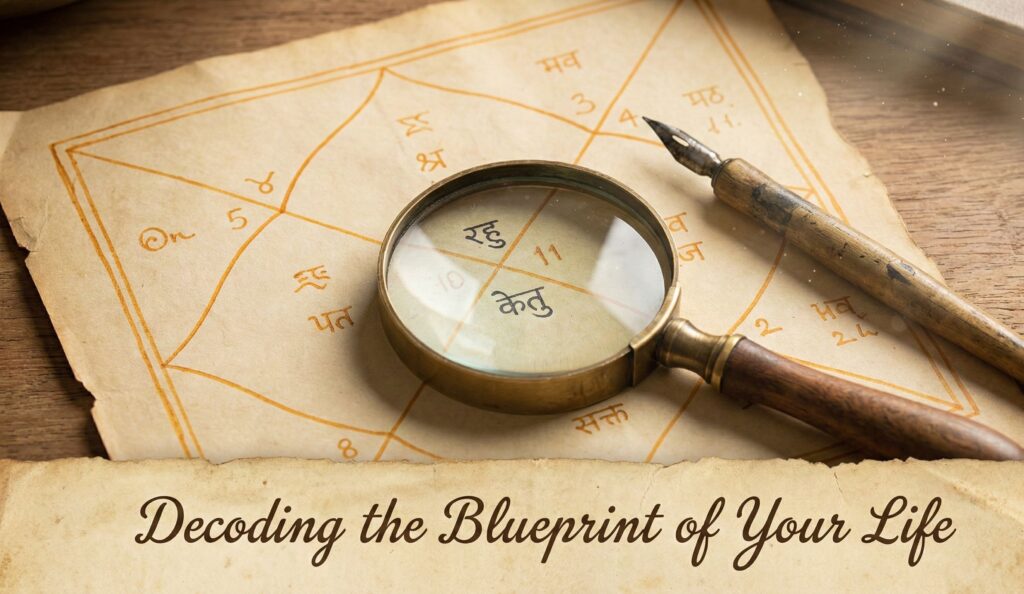
According to Vedic Astrology, Manglik Dosha occurs when the fiery planet Mars (Mangal) is positioned in the 1st, 4th, 7th, 8th, or 12th house of a person’s birth chart.
Mars is a planet of energy, aggression, ego, and self-esteem. When it sits in these sensitive houses, it impacts specific aspects of life:
1st House (Lagna/Ascendant): Represents the self and personality.
4th House: Represents domestic happiness, the mother, and emotional comfort.
7th House: The primary house of marriage, partnership, and the spouse.
8th House: Represents longevity, in-laws, and sudden events.
12th House: Represents expenditure, losses, and bedroom pleasures.
If Mars resides in any of these houses, the person is termed a “Manglik.” The belief is that the aggressive energy of Mars can cause friction, disagreements, or deeper problems in marital life if not properly matched.
Not All Mangliks Are the Same
It is important to understand that the intensity of this Dosha varies. It can appear in:
Lagna Kundali (Ascendant Chart)
Chandra Kundali (Moon Chart)
Navamansa Chart (D9 Chart)
If Mars is present in these positions in only one chart, the Dosha is considered “Low” or mild. However, if it repeats across two or more charts (e.g., it is in the 7th house in both the Lagna and Moon charts), the effects are considered stronger, often referred to as “High Manglik” or Purna Manglik.
The Effects of Kuja Dosha on Life and Marriage
The impact of Manglik Dosha differs from person to person. While some may feel it intensely, others may barely notice it, depending on the other planetary alignments. However, traditionally, the following effects are often associated with this placement:
Delay in Marriage: One of the most common issues is difficulty in finding a suitable match or facing constant obstacles in finalizing the alliance.
Disharmony in Marriage: High volatility, temper issues, and “mismatch thinking” (compatibility issues) between partners can lead to frequent quarrels.
Professional Struggles: Apart from marriage, an afflicted Mars can sometimes lead to a late start in one’s career or irregular education.
Health and Childbirth: In some cases, it may cause health issues for the spouse or difficulties regarding progeny.
Separation: In extreme cases without remedies, it is believed to lead to divorce or separation.
Busting the Myths: Is it Really Dangerous?
There is a lot of fear-mongering surrounding Manglik Dosha. It is vital to separate superstition from astrological logic.
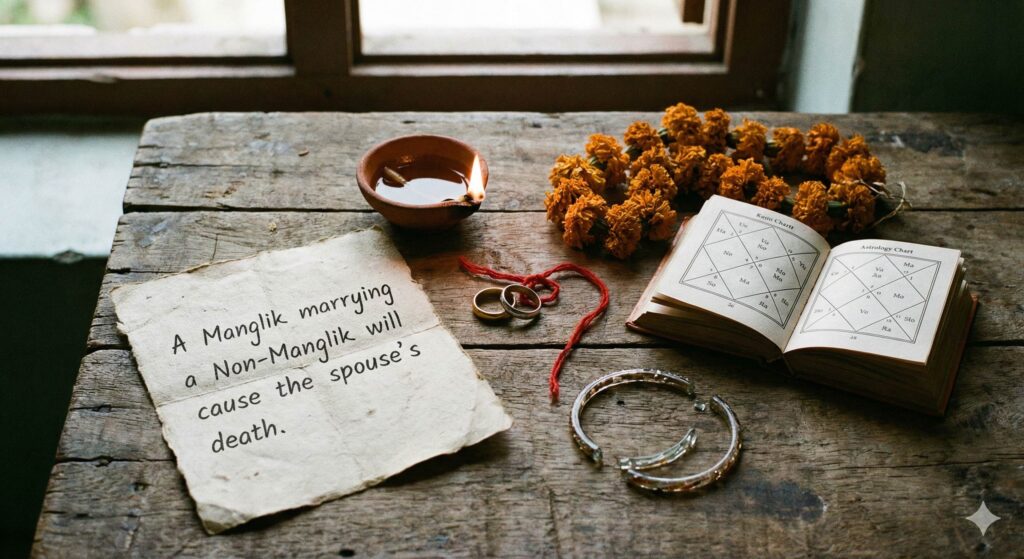
Myth: “A Manglik marrying a Non-Manglik will cause the spouse’s death.”
The Truth: This is the biggest misconception. While the 8th house placement affects longevity, the “death of a spouse” is an extreme and rare prediction that depends on the entire chart, not just one planet. Millions of Mangliks marry Non-Mangliks and live long, happy lives after performing simple Shanti (remedies) or because of other neutralizing factors in their charts.
Myth: “Manglik Dosha leads to divorce.”
The Truth: Mars represents energy. If a Manglik person (high energy) marries another Manglik person, the energies balance out—this is called “Manglik Dosha Cancellation.” Even if married to a non-Manglik, compatibility can be achieved through understanding and remedies.
Conclusion and Remedies
In our Indian culture, we believe that for every problem, the Shastras provide a solution. If you have Kuja Dosha, there is no need to panic.
Manglik Dosha Cancellation (Bhang) occurs naturally in many charts—for example, if Mars is in its own sign (Aries or Scorpio) or exalted (Capricorn), the ill effects are significantly reduced.
However, if you are concerned, there are several Vedic remedies:
Kumbh Vivah: A ritual marriage to a pot or an idol of Vishnu/Krishna before the actual wedding.
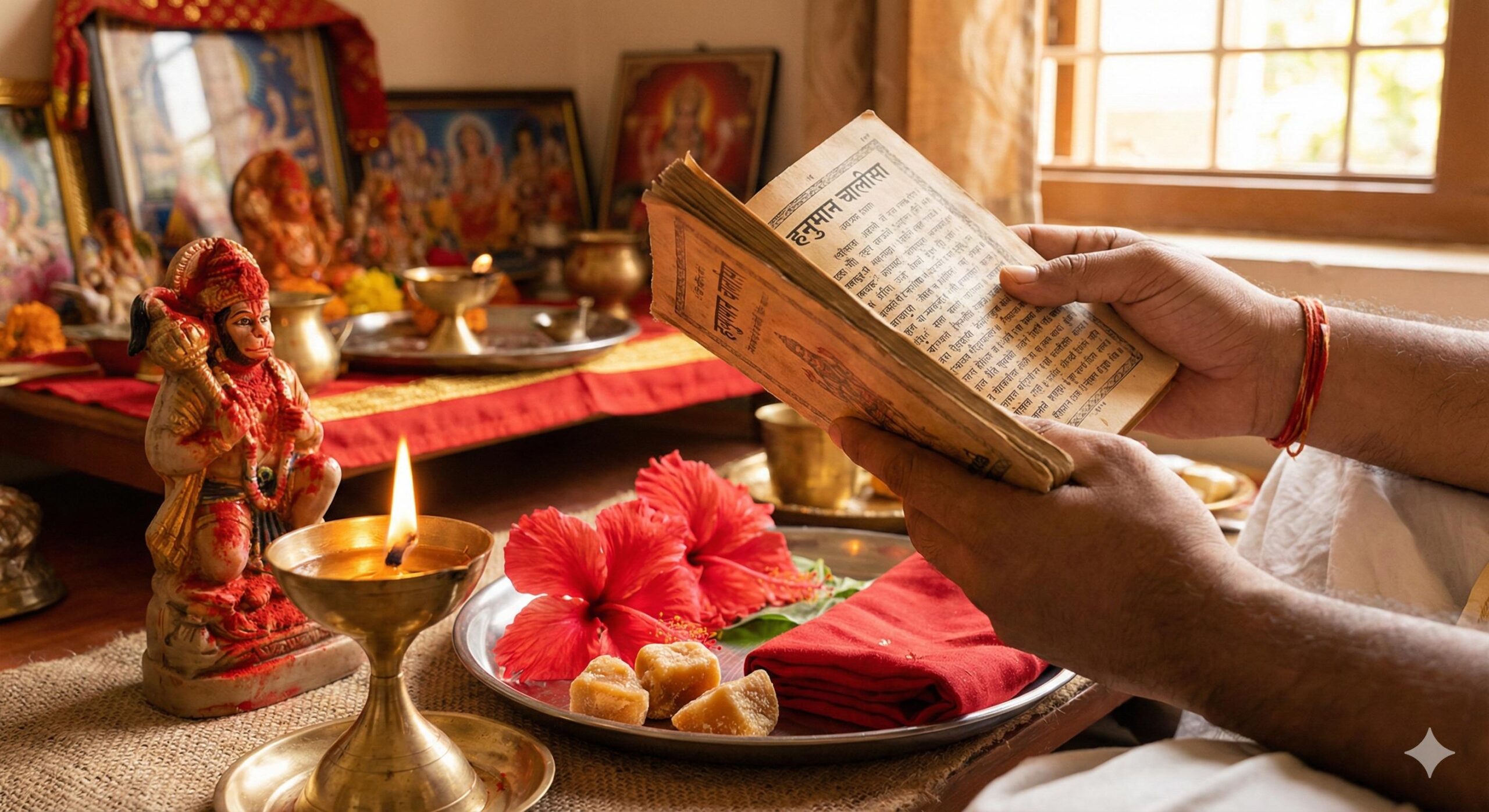
Chanting: Reciting the Hanuman Chalisa or Mantras for Mangal Graha.
Fasting: Observing fasts on Tuesdays.
Astrology is a guiding light, not a frightening sentence. If you believe in the influence of the planets, consulting a knowledgeable astrologer to analyze the Navamansa and Bhav charts is always the best step forward.
In the realm of Indian matchmaking and Vedic Astrology, few terms carry as much weight—or cause as much anxiety—as Manglik Dosha. Also known widely as Kuja Dosha, Bhom Dosha, or Angaraka Dosha, this planetary condition is a critical factor when matching Kundalis (horoscopes) for marriage.
But what exactly is it, and does it truly spell doom for a couple? Let us decode the influence of Mars (Mangal) on your life.
What is Manglik Dosha?
According to Vedic Astrology, Manglik Dosha occurs when the fiery planet Mars (Mangal) is positioned in the 1st, 4th, 7th, 8th, or 12th house of a person’s birth chart.
Mars is a planet of energy, aggression, ego, and self-esteem. When it sits in these sensitive houses, it impacts specific aspects of life:
1st House (Lagna/Ascendant): Represents the self and personality.
4th House: Represents domestic happiness, the mother, and emotional comfort.
7th House: The primary house of marriage, partnership, and the spouse.
8th House: Represents longevity, in-laws, and sudden events.
12th House: Represents expenditure, losses, and bedroom pleasures.
If Mars resides in any of these houses, the person is termed a “Manglik.” The belief is that the aggressive energy of Mars can cause friction, disagreements, or deeper problems in marital life if not properly matched.
Not All Mangliks Are the Same
It is important to understand that the intensity of this Dosha varies. It can appear in:
Lagna Kundali (Ascendant Chart)
Chandra Kundali (Moon Chart)
Navamansa Chart (D9 Chart)
If Mars is present in these positions in only one chart, the Dosha is considered “Low” or mild. However, if it repeats across two or more charts (e.g., it is in the 7th house in both the Lagna and Moon charts), the effects are considered stronger, often referred to as “High Manglik” or Purna Manglik.
The Effects of Kuja Dosha on Life and Marriage
The impact of Manglik Dosha differs from person to person. While some may feel it intensely, others may barely notice it, depending on the other planetary alignments. However, traditionally, the following effects are often associated with this placement:
Delay in Marriage: One of the most common issues is difficulty in finding a suitable match or facing constant obstacles in finalizing the alliance.
Disharmony in Marriage: High volatility, temper issues, and “mismatch thinking” (compatibility issues) between partners can lead to frequent quarrels.
Professional Struggles: Apart from marriage, an afflicted Mars can sometimes lead to a late start in one’s career or irregular education.
Health and Childbirth: In some cases, it may cause health issues for the spouse or difficulties regarding progeny.
Separation: In extreme cases without remedies, it is believed to lead to divorce or separation.
Busting the Myths: Is it Really Dangerous?
There is a lot of fear-mongering surrounding Manglik Dosha. It is vital to separate superstition from astrological logic.
Myth: “A Manglik marrying a Non-Manglik will cause the spouse’s death.”
The Truth: This is the biggest misconception. While the 8th house placement affects longevity, the “death of a spouse” is an extreme and rare prediction that depends on the entire chart, not just one planet. Millions of Mangliks marry Non-Mangliks and live long, happy lives after performing simple Shanti (remedies) or because of other neutralizing factors in their charts.
Myth: “Manglik Dosha leads to divorce.”
The Truth: Mars represents energy. If a Manglik person (high energy) marries another Manglik person, the energies balance out—this is called “Manglik Dosha Cancellation.” Even if married to a non-Manglik, compatibility can be achieved through understanding and remedies.
Conclusion and Remedies
In our Indian culture, we believe that for every problem, the Shastras provide a solution. If you have Kuja Dosha, there is no need to panic.
Manglik Dosha Cancellation (Bhang) occurs naturally in many charts—for example, if Mars is in its own sign (Aries or Scorpio) or exalted (Capricorn), the ill effects are significantly reduced.
However, if you are concerned, there are several Vedic remedies:
Kumbh Vivah: A ritual marriage to a pot or an idol of Vishnu/Krishna before the actual wedding.
Chanting: Reciting the Hanuman Chalisa or Mantras for Mangal Graha.
Fasting: Observing fasts on Tuesdays.
Astrology is a guiding light, not a frightening sentence. If you believe in the influence of the planets, consulting a knowledgeable astrologer to analyze the Navamansa and Bhav charts is always the best step forward. .
Manglik Dosha: Cancellations, Exceptions, and Powerful Remedies
In Vedic Astrology, while the term Manglik Dosha often brings worry to parents and individuals seeking marriage, there is a very important concept known as Manglik Dosha Bhang (Cancellation).
It is said in our Shastras that “Exceptions are always more powerful than the rules.” In many cases, even if Mars is positioned in the 1st, 4th, 7th, 8th, or 12th house, the negative effects are nullified due to the specific placement of other planets or the sign Mars is residing in.
Here is a detailed guide on when Manglik Dosha gets cancelled and the remedies you can perform to bring peace and harmony to your life.
When is Manglik Dosha Cancelled? (Exceptions)
Not every person with Mars in the sensitive houses is truly Manglik. The ill effects of Kuja Dosha are considered cancelled or “neutralized” under the following specific astrological conditions:
1. Mars in its Own or Exalted Signs
The Dosha is automatically cancelled if Mars is placed in its own house or its sign of exaltation. This includes:
Aries (Mesha) and Scorpio (Vrishchika): Mars is in its own home.
Capricorn (Makara): Mars is exalted (uchcha) here.
Friendly Signs: If Mars is sitting in the houses of its friends—Sun (Leo), Moon (Cancer), or Jupiter (Sagittarius/Pisces)—the severity is drastically reduced.
2. Specific Ascendant (Lagna) Rules
The placement of Mars acts differently depending on your rising sign:
Gemini and Virgo: If Mars is positioned in the 2nd house, the Dosha gets cancelled.
Taurus and Libra: If Mars is positioned in the 12th house, it is considered an exception.
Cancer and Capricorn: If Mars is positioned in the 7th house, the negative effects are nullified.
Sagittarius and Pisces: If Mars is positioned in the 8th house, the Dosha is cancelled.
Aquarius Ascendant: If Mars is placed in either the 4th or 8th house, the Manglik Dosha does not apply.
3. The Fortune of Leo and Cancer
According to certain astrological texts, if Mars is placed in the rashis (signs) of Leo or Cancer, it brings good fortune rather than harm, acting as a significant exception to the rule.
Vedic Remedies for Manglik Dosha
If your chart does not fall under the exceptions above, or if you simply wish to pacify the fiery energy of Mars for a happy married life, our tradition offers simple yet powerful remedies (Upay).
Here are the most effective ways to please Mangal Graha:
1. Worship of Lord Hanuman
Lord Hanuman is the supreme deity to control the energy of Mars.
Hanuman Chalisa: Make it a strict habit to chant the Hanuman Chalisa daily. This is considered the most effective remedy.
Sunder Kand: For a period of 40 days, recite the Sunder Kand from the Tulsi Ramcharitmanas. For best results, begin this practice on a Tuesday.
Temple Visits: Visit a Hanuman temple every Tuesday. Offer Sindoor (vermilion), sweets (Prasad), and light a ghee lamp to seek blessings.
2. Fasting (Vrat)
Fasting is a great way to cleanse the body and mind.
Observe a fast on Tuesdays.
Tip: It is best to start this fasting routine on the first Tuesday of a new month during Shukla Paksha (the rising/waxing phase of the moon).
3. Gayatri Mantra
Reciting the holy Gayatri Mantra 108 times a day helps in calming the mind and reducing the aggressive tendencies associated with an afflicted Mars.
4. Acts of Charity (Daan)
Donation is a noble way to clear karmic debts.
Red Cloth & Iron: Mars represents the color red and the metal iron. To cancel the ill effects, donate red clothes to workers or laborers.
Specific Donation: It is highly beneficial to donate specifically to workers who use sharp iron tools (like construction workers or smiths), as they are governed by Mars.
A Final Note
Remember, Astrology is a tool for guidance, not fear. Manglik Dosha is simply an indication of high energy that needs to be channelled correctly. With the right match and the right remedies, a Manglik individual can lead a prosperous and happy married life.
How to remove negative energy from home Vastu, How to tell partner I am Manglik, Manglik dosha effects on career growth, Low Manglik vs High Manglik difference, Simple Manglik dosha remedies at home, Kundali matching for modern dating apps, Manglik dosha cancellation for Aquarius ascendant, Best gemstones for Manglik dosha relief, Psychological impact of Manglik dosha fear, Manglik boy and non Manglik girl marriage. Kuja Dosha vs Manglik Dosha difference, Is Manglik dosha valid after age 28, Astrology apps for detailed Kundali Dosha report, Marriage problems due to Nadi Dosha, Manglik dosha and delayed child birth, Scientifically explaining Manglik dosha to skeptics,