

Chiromancy (Palm Reading) Definition
Chiromancy, widely known as palmistry, is the art of analyzing character and fortune by interpreting the features of the hand. This practice involves examining the lines, mounts (bumps), finger shapes, and nails to gain insight into an individual’s personality and potential,. The discipline is actually a sub-section of a vast, ancient field of study known as “Samudrik Shastra,” which translates from Sanskrit as “the ocean of knowledge” and encompasses the interpretation of various body features. Specifically, the study of the hand is referred to as “Hasta Samudrika Shastra”.
While the term chiromancy specifically refers to the study of the lines, the broader practice often incorporates chirognomy, which is the study of the hand’s shape, size, and appearance, as well as dermatoglyphics, the study of skin ridges and fingerprints,,. Fundamentally, palmistry is viewed as a method of personal counseling and self-discovery rather than merely predicting a fixed future,.
Historical Roots
The history of palmistry spans thousands of years, with origins traced back to India and China as early as 3000 to 3110 BCE

Ancient Civilizations:
- The practice captivated many ancient cultures, including the Sumerians, Babylonians, Tibetans, Persians, and Egyptians. In the Judaic sphere, chiromancy appeared in the circle of Merkabah mysticism, serving as a method to determine if a person was fit to receive esoteric teachings,.
Greece and Rome:
- The practice reached classical Greece by the fourth century BCE. Philosophers such as Anaxagoras regarded it as a study worthy of an educated mind, and Aristotle observed that lines in the hand were associated with the length of life,. In Roman history, legend suggests that Julius Caesar used palmistry to judge his men, though some scholars argue this is a myth and that the Roman ruling class actually preferred astrology,,.
The Middle Ages and Renaissance:
Contrary to the belief that the Church completely banned the practice, many Popes during the Middle Ages studied subjects like astrology and palmistry. The art was reintroduced to Europe during the 12th century, likely by Crusaders returning with manuscripts from the Middle East rather than by Gypsies, who arrived later in the 15th century,. By the Renaissance, palmistry was sufficiently respected to be part of the official curriculum at universities such as Leipzig, Bologna, and Wittenberg,.
Modern Era:
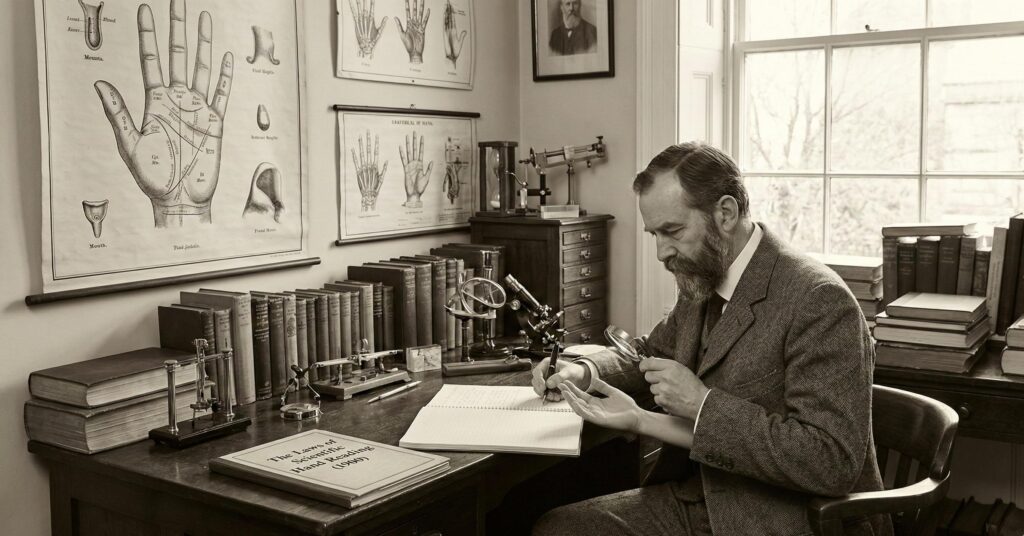
After a decline in the 18th century, the practice saw a revival in the late 19th century, notably through William Benham, who introduced a scientific approach to hand reading in 1900,.
The Concept
The core philosophy of palmistry is that the hand acts as a “map of life” or a “circuit board” for the brain,.
- Mind-Body Connection: Neurosurgeons have observed that the lines in the palm are created by nerve endings originating in the middle brain. Consequently, both conscious and unconscious thoughts generate bio-electrical impulses that are transmitted to the hands, forming lines over time,. This concept suggests that just as a pebble creates ripples in water, thoughts create effects on the palms.
- Dynamic Nature: A crucial concept in palmistry is that the lines are not set in stone. Because the lines reflect a person’s attitudes and experiences, they change as the person changes. Therefore, the lines represent potential outcomes rather than an unchangeable fate; if a person alters their thinking or lifestyle, their lines will reflect those new patterns,.
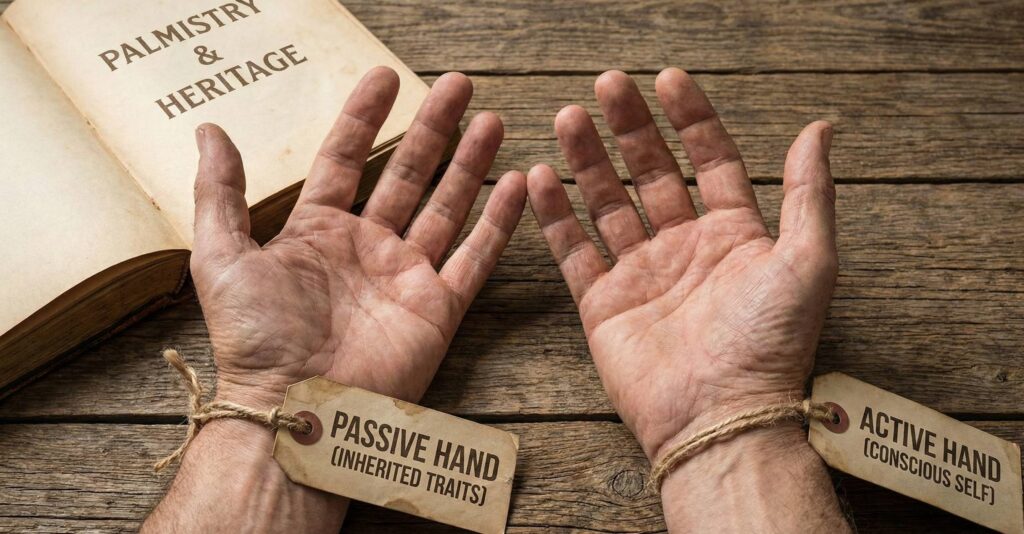
- Active vs. Passive Hands: Palmistry differentiates between the two hands. The passive hand (usually the left for right-handed people) reveals inherited traits, the subconscious, and the potential one is born with,,. The active hand (usually the right) represents the “hand you make,” reflecting the conscious self, current accomplishments, and how one has utilized their potential,. In some ancient Judaic traditions, however, the right hand was the determining factor for males and the left for females.